

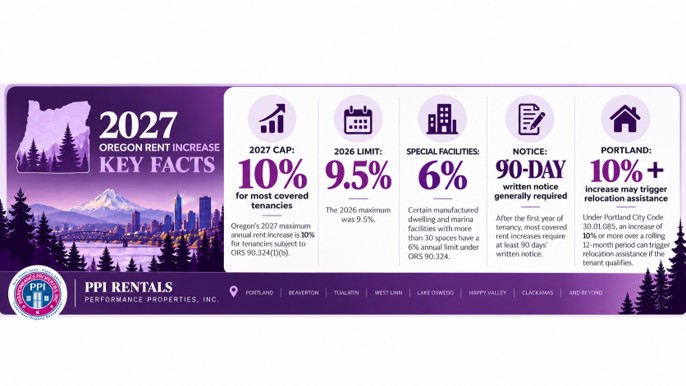
Oregon landlords have an important number to plan around in 2027: 10%. The Oregon Department of Administrative Services announced that 10% is the maximum annual rent increase for most covered residential tenancies in 2027, up from 9.5% in 2026. But that number is a legal ceiling, not a signal that every rental owner should automatically raise rent by the full amount. Property age, notice timing, lease history, and local regulations all matter. For owners in Portland, Beaverton, Tualatin, West Linn, Lake Oswego, Clackamas, and nearby communities such as Happy Valley, understanding these rules is essential. This guide explains how Oregon’s 2027 rent increase limit works, what landlords should watch for, and how Performance Properties Inc. (PPI Rentals) helps local owners protect income while staying compliant.
What Is Oregon’s 2027 Rent Increase Limit?
Oregon’s rent stabilization law limits how much many landlords can increase rent each year for covered residential tenancies. For most qualifying tenancies, the annual increase is capped at the lower of 10% or 7% plus the Consumer Price Index (CPI). For calendar year 2027, the State of Oregon published the maximum allowable increase for tenancies subject to ORS 90.324(b) as 10%. In 2026, the maximum for those same tenancies was 9.5%. Certain manufactured dwelling and marina facilities with more than 30 spaces are instead subject to a 6% annual limit.
Calendar Year | Maximum for Most Covered Tenancies |
2025 | 10% |
2026 | 9.5% |
2027 | 10% |
Why Is Oregon’s 2027 Rent Increase Limit Important?
Protecting rental income
Property taxes, insurance, maintenance, and turnover affect returns. A lawful, carefully planned adjustment can help owners cover expenses and preserve investment performance.
Preventing costly legal mistakes
An unlawful increase can create significant risk. Oregon law includes notice requirements and rent cap rules for covered tenancies. If an owner increases rent improperly, the financial consequences can be much greater than the extra rent they hoped to collect.
Supporting better tenant retention
Maximum increases do not suit every property. Retaining a reliable tenant may be more profitable than risking vacancy. This matters across Beaverton, Lake Oswego, Tualatin, and West Linn.
Helping owners plan strategically
At PPI Rentals, rent strategy is not just about what is legally allowed. It is also about market positioning, tenant quality, maintenance planning, and protecting long-term asset performance. PPI Rentals supports owners with rental market analysis, tenant screening, maintenance coordination, rent collection, and financial reporting.
Key Factors to Consider
Property age and exemptions
Check if the statewide cap applies. Units with a first certificate of occupancy issued less than 15 years before the notice may qualify for an exemption. Some regulated affordable housing also follows different rules.
Timing and frequency
For most residential tenancies covered by Oregon’s general rules, a landlord may not raise rent during the first year of the tenancy. After that, a rent increase generally cannot happen more than once in a 12-month period. Before raising rent, review the move-in date, lease terms, and last increase date.
Written notice requirements
Most covered residential tenancies require at least 90 days’ written notice before a rent increase takes effect. The notice should clearly identify the current rent, new rent, effective date, and any required exemption language where applicable.
Local rules in Portland
State law is only part of the picture. If the property is within Portland city limits, local renter protection rules may create additional obligations. That makes city-level review essential before sending any notice.
Market conditions by area
Rental pricing should reflect neighborhood realities. A strategy that makes sense in Portland may not be ideal for Clackamas, West Linn, or Tualatin. Likewise, properties in Lake Oswego or Beaverton may justify a different approach based on condition, competition, and tenant profile. Owners near Happy Valley should also pay close attention to nearby market expectations and renter behavior.
How Does Oregon’s 2027 Rent Increase Work?
- Step 1: Confirm whether the property is covered by Oregon’s rent cap rules.
- Step 2: Verify the tenant is past the first year and confirm no increase was issued during the prior 12 months.
- Step 3: Calculate the increase using the current rent and allowable percentage.
- Step 4: Review local compliance issues, especially if the property is in Portland.
- Step 5: Prepare and deliver written notice, then keep proof of delivery.
- Step 6: Retain documentation such as lease dates, notice copies, and calculation backup.
Example: If current rent is $2,000, a full 10% increase would be $200, making the new monthly rent $2,200, assuming the tenancy qualifies and all legal requirements are met.
Costs / Benefits / Requirements
Current Monthly Rent | 10% Increase | New Monthly Rent | Extra Annual Rent |
$1,200 | $120 | $1,320 | $1,440 |
$1,500 | $150 | $1,650 | $1,800 |
$1,800 | $180 | $1,980 | $2,160 |
$2,000 | $200 | $2,200 | $2,400 |
$2,500 | $250 | $2,750 | $3,000 |
Higher rent does not guarantee higher net income. Vacancy, cleaning, leasing, and turnover can erase gains. A balanced plan weighs compliance, pricing, retention, and maintenance.
Local Information
PPI Rentals serves property owners across Portland, Beaverton, Clackamas, West Linn, Tigard, Tualatin, Lake Oswego, Canby, Milwaukie, and Hillsboro. For owners in these markets, local conditions can influence whether a full increase is smart, even when it is technically allowed. PPI Rentals helps owners evaluate market positioning, tenant quality, maintenance needs, and compliance so rent decisions support long-term performance rather than short-term gain.
Portland relocation assistance rules
Within Portland city limits, a rent increase of 10% or more over a rolling 12-month period can trigger mandatory renter relocation assistance if the tenant follows the required process and no exemption applies. Portland also requires written notice at least 90 days before the increase becomes effective.
Portland Rental Unit | Relocation Assistance |
Studio / SRO | $2,900 |
1 Bedroom | $3,300 |
2 Bedroom | $4,200 |
3+ Bedrooms | $4,500 |
This is especially important for Portland landlords considering the full 10% increase. A legally allowed increase may still create added cost under city rules. Owners in Beaverton, Tualatin, West Linn, Lake Oswego, Clackamas, and nearby areas such as Happy Valley also benefit from reviewing broader Portland-metro competition and renter expectations before adjusting rates.
Common Questions About Oregon’s 2027 Rent Increase Limit
1. Can landlords raise rent by 10% in 2027?
For many covered residential tenancies, 10% is the maximum allowable annual increase in 2027. Owners must still meet legal timing, notice, and eligibility requirements.
2. Can rent increase during the first year of tenancy?
Generally, no. For most covered residential tenancies, Oregon law does not allow rent increases during the first year.
3. Is a 90-day written notice required?
Yes, for most covered rent increases after the first year of tenancy, at least 90 days’ written notice is generally required.
4. Are newer properties exempt from the cap?
Some newer properties may be exempt if the first certificate of occupancy was issued less than 15 years before the notice date.
5. Does Portland have its own additional rules?
Yes. Portland has renter protection rules that can trigger relocation assistance when rent increases reach 10% or more over a rolling 12-month period.
6. Should every landlord use the full 10% increase?
Not necessarily. The best decision depends on expenses, market conditions, tenant retention, and the property’s long-term goals.
Conclusion
Oregon’s 2027 rent increase limit gives landlords a clear statewide benchmark, but the smartest rent decisions require more than simply applying the maximum number. Property coverage, tenant timing, written notice, and local rules—especially in Portland—must all be reviewed carefully. For owners in Portland, Beaverton, Tualatin, West Linn, Lake Oswego, Clackamas, and nearby communities such as Happy Valley, the right strategy is one that protects income without increasing avoidable risk. A careful rent review can support stronger cash flow, better tenant retention, and fewer compliance issues. With experienced local guidance, owners can make decisions that align with both Oregon law and long-term investment performance.